I was practicing a bit of Soldier Blade over the weekend, trying to focus on just one level at a time and learn the layouts. It's hard to compare shmups over a long span of time, as even minor skill improvements can reframe an entire game. But looking at just the few I've played recently (Axelay, Cho Aniki, R-Type, S&P if you want to count that), two things stand out about Soldier Blade.
First is that it's really fast - not an original or particularly interesting revelation. But compounded with the 45-minute length (longish, compared to the 30-min norm), it means tons of content spewing from just a single loop. Not that I've taken the time to count waves, but it at least feels like three of R-Type's levels could fit in one of Soldier Blade's.
That said, the excess is packed with a hefty supply of popcorn*. Admittedly, Axelay and R-Type are self-consciously stripped down games, and Cho Aniki is... something else in terms of level design (not good), so Soldier Blade's ratio feels closer to average. It's not even bad popcorn - most of it comes at weird angles that make your weapon level relevant (always a bad time to have Blue 1) - it's just that at the rate the game moves, it adds up quickly. It isn't afforded the same level of variation as the primary waves (nor should it be if it needs to remain low-engagement), so you see the same couple waves in every level.
A third note that I knew already, but contributes to the same conclusion: the x-axis orientation of some enemy patterns is determined reactively by the player ship's position. That is, if Soldier Ship is on the left half of the screen, a string of popcorn may stream in from the top right corner, but if positioned on the right the same wave would come in from the top left. Since this behavior is specific only to certain waves, the stage doesn't just flip-flop - relative enemy positions will actually change.
What this adds up to is a game resistant to idle memorization. I don't consciously commit shooters to memory (I don't know that I could), but after a degree of practice it becomes instinctual. With high speeds requiring high response time, enemy spawn points derived from player position, and a relatively limited weapon swap, Soldier Blade places value beyond the obvious on knowing what's next. Yet it readily defies the patterns that make this knowledge a subconscious product. The layout density creates an excess of information to store. The uniform popcorn puts just enough space between distinct encounters that the concatenation of "Wave A, then Wave B, then Wave A, then Wave AB" requires an investment of active memorization (while fighting popcorn: "Wave C came last, Wave C came last, Wave C came last"). And the reactive spawning does more than mix things up - it adds pre-wave activity to the necessary data set for layout prediction.
It's an effect well-coordinated with Soldier Blade's presentation and balancing to make the game feel especially lively and engaging through repeated plays, moreso than just being "fast". Particularly satisfying is seeing this kind of spontaneity evinced through techniques not reliant on randomly generated elements or structural flattening.
*"Popcorn" is a term used by shooting game enthusiasts to denote waves of one-hit-point enemies that typically don't fire projectiles. For example, the first few waves of any given stage of Gradius. Popcorn isn't meant to defeat the player, instead it keeps them lightly engaged while creating some breathing room. Think of it like the foam packing peanuts in a shipping container - not what you're after, but necessary to fill out a stable, symmetrical structure. I came up with that metaphor because I thought the packing material was called popcorn, then as I wrote it out I was like, wait.
Showing posts with label turbografx. Show all posts
Showing posts with label turbografx. Show all posts
Monday, April 3, 2017

Wednesday, August 14, 2013
Come on Gradius II, you KNOW I have OCD

|
at 5:33 PM | games gradius turbografx what I'm playing |
I know I said this wasn't going to turn into some kind of Gradius fan-blog, but apparently, it did?
I've been so fucking hung up on Gradius II in the past week, and I don't mean I've played through it like eighteen times, I mean it's taken about five days to complete just five levels.

A little background here - I love shmups. I've probably mentioned that before. They're both a guilty pleasure and a genuine intellectual interest of mine, and I will play (or at least try) just about any.
On the flipside, I suck at shmups. I've never been reflex Johnson, I have no sense of rhythm, I can't learn kinesthetically, and therefore, I'm really bad at replicating, repeating, and improving upon precise inputs. This has a lot of fun widespread implications, like that I can't play instruments or sports, but more importantly, it means I'm almost comically bad at precise action games. Fighting games are the worst (lame, as I also love fighting games), but shmups really hurt too. I'm not trying to paint this like a disability or something, I still have fun. Just suck, and always have to take it with a grain of salt when someone says "this game is hard at first, but after playing for a while it'sa no problemo!"
The complicating factor is that I'm pretty much obsessive compulsive. Maybe I never bothered to whine at a doctor, but how many people do you know who wash their feet every time they touch the floor? This mental defliction has a twofold application to shmups: first, I play every game (shmup or otherwise) on Normal difficulty the first time through, no matter what. I will never turn the difficulty down to Easy unless I have some kind of ulterior motive (like if I'm trying to get video of Easy mode... I'm not that crazy). Second is that I can't stand using continues/lives beyond the initial supply (i.e. "inserting credits"). I literally can't have fun if I'm using difficulty crutches - my brain won't allow me. But I also suck. So what you get is that I just don't finish a lot of shmups.
Man what was the point of this post. I wrote that title/opening a few weeks ago and now I honestly have no idea where I was going with it. Or if I was going anywhere. There has to have been some specific way I was going to tie it to Gradius II.
I think it's that I broke my rule about no continues because Gradius II is really hard but also has well-contained levels that don't really bow down to a full set of power-ups, so you may as well play each one as an individual game. Not to mention that my degrading quality of play over the course of a session would mean that after about an hour, I would be losing on Stage 1 about 75% of the time, and therefore was spending the lion's share of my playtime on... Stage 1. Which I knew I could beat. But because I broke my rule, I had to make a trade, which was that I would beat a level every time I sit down to play. If I'm gonna continue infinitely, then I need to force progress somehow, such that I don't sit down to the exact same level every time I play (again, boring). And I really wanted to beat the game. So I've gotten into these long sessions that drag on endlessly because my best few attempts come at the beginning and then my concentration fades and I start having a lot of stupid deaths, but I insist on continuing because the idea of stopping is too frustrating to even consider.
So then there was a pure memorization level, and my patience was really put to the test. And in the end, I gave up. And guess what? I haven't played Gradius II since. That's what happens when you break your promises. That's why you never get out of the tree.
Thursday, May 23, 2013
Let's Listen: Beasts as Black as Night
|
|
at 10:42 AM | genesis let's listen music snes turbografx ys |
You're probably familiar with the old saying, "You can always judge an RPG soundtrack by its boss tune." Boss anthems are hardly ever the most emotive or interesting songs on a soundtrack, but there's something irresistible about their sense of dire emergency. I'm here today to talk about Beasts as Black as Night, the boss theme for Ys III.
What happens when you release the same RPG across multiple platforms? Ys III takes the route of using the same soundtrack on each console.
What happens when you release the same RPG across multiple platforms? Ys III takes the route of using the same soundtrack on each console.
SNES
This is why that route is oft regrettable. In a Controversial Blogging Choice, I'm leading an article about one song with a bad example of that song.
Say what you will about the SNES, its synths hold up pretty well. The SNES version of Beasts as Black as Night, however, doesn't understand what to do with them. The lead instrument (0:12) is too contemplative to fit the urgent role of the lead melody. Equally puzzling is the pan flute used for the rapidly moving background instrument (0:00) which works more by chance than anything.
(Look to Nobuo Uematsu's SNES Final Fantasy soundtracks for songs that don't press the hardware but still pack in plenty of emotion and panache. For a soundtrack that tailors its sound to the console, check out Mortal Kombat SNES vs. Genesis.)
(Look to Nobuo Uematsu's SNES Final Fantasy soundtracks for songs that don't press the hardware but still pack in plenty of emotion and panache. For a soundtrack that tailors its sound to the console, check out Mortal Kombat SNES vs. Genesis.)
Genesis
The Genesis version finds siblings in the PC-88 and X68000 versions, but its production takes the lead by a nose. Just like the title, every instrument in here is dark and searing. Am I getting too flowery?
The fun of Beasts as Black as Night kicks off immediately (well, 0:05) with a guitar that spirals violently downward, marked spooky by a whistle in the distant background. Out of the soundtracks limited to hardware synths, the Genesis version is the best-produced not only for its synths but for its attention to mastering.
The fun of Beasts as Black as Night kicks off immediately (well, 0:05) with a guitar that spirals violently downward, marked spooky by a whistle in the distant background. Out of the soundtracks limited to hardware synths, the Genesis version is the best-produced not only for its synths but for its attention to mastering.
TurboGrafx-CD
But the TurboGrafx-CD version wasn't limited to hardware synths. It may be cheating, but the TG-CD version is my personal favorite. Most CD consoles back in the day (early 90s) had a penchant for overblown rock music, but Ys III does that one better and mixes in plenty of weird synths. I like to think that the lead synth is a bassoon!! The point is, this version--without going too far--has flakes of the unusual in its instrumentation.
Notable features of this version are the solo at 1:21 and the breakdown + solo at 2:52.
(For an overblown rock CD soundtrack, I think everyone's favorite example is Lords of Thunder.)
Unfortunately, there are some versions I couldn't find. I'd love to hear the MSX version, for instance. However, I would be remiss if I didn't at least link you to the Oath in Felghana version, which is overblown in a more orchestral and less weirdo synth way. Most of my talk was about instrument choice, but I guess that's what happens when you take a simple song and discuss it three times over.
Monday, January 7, 2013
Try this game: Cottoning to Cotton
|
|
at 6:24 PM | arcade cotton genesis give this game a shot snes turbografx |
You're forgiven if you've never heard of Cotton. In the name of the Father, the Son, and the Holy Spirit. Go now in love and peace to serve the SNES. Amen.
Does the word "cotton" meaning "to come to like" come from a mispronunciation of "caught on"? Perhaps with some kind of Boston accent? Seems wildly unlikely. Etymologists, write in.
 |
| Seriously, Ad Caption Guy??? |
Cotton is a pretty tiny series of shoot-'em-ups (shmups) spanning from the early '90s to about '03. The chronology is so convoluted that I'm just going to refer you to Hardcore Gaming 101, though suffice to say that there are only two primary series entries: Cotton: Fantastic Night Dreams and Cotton 2: Magical Night Dreams, both of which debuted in arcades and were subsequently ported/arranged*/spun-off onto every major Japanese console of the time. Only a single - hilariously chosen - release ever made it to the West: the Turbo-CD port of the first arcade game. The series graced every console from the Famicom (NES) to the Dreamcast, yet the publishers chose the Turbo-CD version to bring to North America? Did you know that less than three (3!) Turbo-CD units were owned by live humans in its active lifespan? Did you know that if there were as many humans as there are molecules in the universe, and were the Turbo-CD's sales numbers adjusted proportionally, it still would have moved less units than the N64 did with Earth's existent population of ~6 billion? Did you know that science considers it a statistical impossibility to own a Turbo-CD?
Let me give you a quick sense of Cotton's raison d'raisin before I send you off to your local ROM conservatory to legally enjoy the most fulfilling of life's pleasures, trying out new games. The name itself, Cotton, refers to a lil' witch gal who serves as the series' recurring protagonist, perennially accompanied by one of anime's other great tropes: a completely inappropriately clothed buxom fairy. This bipolar protagonistic pairing sets the scene for a veritable Lethal Weapon of tales, though Cotton ought to be exclaiming "I'm too young for this shit!" in place of Danny Glover's filmic line. Generally the series is undeservedly lumped into that deservedly unpopular subgenre, the cute-'em-up**, but aside from Cotton herself, the game's fantasy setting is relatively dark and serious. Check out these screenshots and videos if you don't believe me.
I've experimented with everything in the series short of Dreamcast's Rainbow Cotton and found that you can basically get the full experience through just three games, which I'll describe in detail... after these messages!
Maerchen Adventure Cotton 100% (Super Famicom):
 |
| A screen from the surprisingly dark arcade original |
For those just being introduced to the shmup, a fast-paced and accessible experience
Though the sprites have strangely become cutesy, this is otherwise what Cotton is all about. A bare-bones level up / down system, one-hit deaths, bouncy power-ups a la Twinbee, and frequent boss battles. The pared down mechanics and forgiving balance make 100% a great place to start for anyone new to the genre. It's not too tough, keeps the scenery changing, and provides a pretty comprehensible scoring mechanic that is instructively tied to power-ups. If Gradius and R-Type scared the shit out of you and Fantasy Zone was a yawn, don't give up on the genre yet - MAC100% may be just the game you're looking for. And PLEASE do me a favor and appreciate the laziest title screen music ever.
Magical Night Dreams: Cotton 2 (Arcade):
For longtime shmup fans looking for a new experience, this is the Mischief Makers of the genre
Cotton 2 is kinda silly for a few reasons - it's definitely one of those games that you may not 'get' after dicking around for ten minutes, then you'll go to Youtube to check out a walkthrough and say, "OHHHHHHHHHHHHHHH". Now that you can skip that step, we can talk about how the entire game revolves around grabbing enemies and tossing them out to ricochet off each other around the planet. In fact, the need to keep alive your makeshift projectiles (by shooting them, re-grabbing them, or making sure they keep hitting enemies) calls to mind pinball - turn the game on its side and turn off the scrolling, and you'd be damn close. It's a neat twist, if not necessarily brilliant, and I certainly can't think of another game that plays the same.
Panorama Cotton (Mega Drive):
For, well, anyone with even the slightest appetite for oldies. If you've enjoyed a single 16-bit game since 1994, you owe it to yourself to track this down
Here's the game that gives the whole series a reason to exist, and as the king of irony (Jeff Daniels) would have it, it's the most unique in terms of gameplay. Panorama Cotton belongs to the tragically small genre of 3D rail-shmups (Star Fox, Space Harrier, and the present day Kid Icarus: Uprising and Sin & Punishment). Fans will get a kick out of seeing all the ideas of the series adapted into this presentation - this is still very much Cotton. Newcomers won't care about that, but have to be impressed by the extent to which the game pushes not just the Genesis, but 2D sprite games altogether. Beautiful aesthetics are about seeing a vision and pushing it through with utter disregard for technical limitation; while Panorama's choppy framerate and jaggies might turn off a blind snob, it's hard not to be blown away when the game takes you swooping over a cliff and down through a waterfall, or up into the skies above the clouds. This is the antithesis of Star Fox, and everything classics are made of. A complete fuck you to what "can" be accomplished.
So go play a Cotton game. Not because you're guaranteed to like it, but because I'm sure at least one of them is like nothing you've played before.
*arrange: a term relating almost exclusively to shmups, an arrange is like a remix of a song - same core elements with a new twist, be it new controls, score mechanics, or power-ups. Think Super Street Fighter II.
**cute-em-up: a shoot-em-up with "cutesy" style graphics and a comic tone, usually with very simple mechanics, large sprites, a slow pace, etc. See: Parodius.
Tuesday, November 6, 2012
Fan Translation Reviews
|
|
at 5:18 AM | fan translations game boy nes reviews turbografx |
Between Ezio's death and that image of Romney as a Vulture Capitalist, things have been serious around here. I figured I'd ease the tension a little with everyone's favorite topic: fan translated games.
These aren't reviews of the translations themselves, but rather, games that happen to have fan translations.
You can find the Getsu Fuuma Den translation here.
You can find the Blue Blink translation here.
You can find the Frogbelltolls translation here.
Don't forget to set your clocks back an hour.
Tuesday, August 7, 2012
Let's Meet Bonk's Adventure - Part 2
|
|
at 7:00 PM | bonk let's meet platformers theory of games turbografx |
In Part 1 of each Let's Meet, you'll find an introduction to a game's history and gameplay. In Part 2, you'll come away with something neat about the game.
Last time, I introduced the powerup system of Bonk's Adventure. Pieces of meat grant you speed and invincibility for a limited time. If you move quickly, you can maintain invincibility. However, if you take time to stop and explore, you'll find plenty of helpful items that will restore your health and earn you lives. This offers two competing methods of play: one fast, one slow.
While the speedy approach appears to be unintentional, it adds some depth to the game. For instance, it makes world 2-2 more interesting than you might first think.


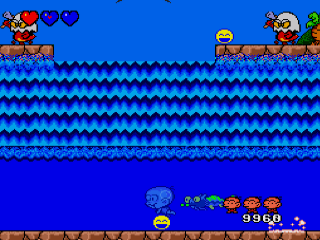


Last time, I introduced the powerup system of Bonk's Adventure. Pieces of meat grant you speed and invincibility for a limited time. If you move quickly, you can maintain invincibility. However, if you take time to stop and explore, you'll find plenty of helpful items that will restore your health and earn you lives. This offers two competing methods of play: one fast, one slow.
While the speedy approach appears to be unintentional, it adds some depth to the game. For instance, it makes world 2-2 more interesting than you might first think.
Early on, the player is given the option to go invincible.
This pink guy holds a large meat, granting you immediate
invincibility. From here, it's a cinch to run ahead along the top of
the falls. Homing mosquitoes (like the one at the top right of this
image) are normally a pain, but invincible Bonk takes them out by
merely touching them.
Plus, Invincible Bonk is helpful for navigating the terrain:

You'll come across this ledge about halfway through the stage. When
invincible (top), Bonk clears it in a single bound--otherwise
(bottom), he's stuck climbing up the side of it.
If you continue along the top of the waterfalls, you'll find just
enough pieces of meat to keep you invincible to the very end of the
stage. For instance, there's one meat-bearing orange flower about
three quarters of the way through the stage which proves crucial to
sustaining invincibility.
However, 2-2 doesn't let the slow player go unrewarded.
While the top of the waterfall is home to hatchet-throwing dinosaurs
and relentless mosquito squads, the lower path is peaceful. If you
let Bonk explore the river below the falls, he'll come across a bunch
of slow-moving enemies that cough up both points and point-bearing
smilies. There are also flowers full of point-yielding prizes beside
the waterfall, making the trek more than a simple swim forward.
Plus, if you swim low, you'll come across an alternative to scaling
that high wall around the midpoint.
This underwater passage leads straight through to the other side of
the cliff.
Unfortunately,
this kind of stage is rare in Bonk's Adventure.
Stages tend to be biased towards one play style or the other.
For instance, 2-3
is a claustrophobic cave stage that offers quite a few passages to
spelunk, forking over plenty of rewards to the curious player.
However, try to play it fast, and you'll find that the hallways are
too tight and the terrain is too bumpy to play with any speed. Couple
that with a lack of meat, and world 2-3 offers nothing for a player
who wants to go fast.
In fact, Bonk's
Adventure comes up with a number
of ways to slow the player. Whether it be walls to climb, tight
passages, swimming through water, or something else, a stage can
really take the wind out of your sails if it wants to. There's even a
slight delay when Bonk starts a jump or lands, making Bonk himself a
slow character.
That's not to say the entire game is like that, though. There are
plenty of stages that favor speed over exploration.
Like 5-4, which
lets the player run free over mostly flat terrain. The stage isn't
boring, though, since it features plenty of enemies and deadly acid
pits. It doesn't hurt that enemies in 5-4 frequently give up pieces
of meat, making it more than possible to chain invincibility
throughout the entire stage.
But then, there
are also the stages which don't provide speed or exploration.
3-5 is one such
stage. In the first half, meat is scarce, and the terrain is very
uneven, restricting you to a slow pace. However, it's all one path
forward, with all of the items and enemies directly on your path. You
won't have much exploring to do.
The stage makes a
change around halfway through, though.
First, the stage
introduces a body of water, which gives the player access to secret
passages. Soon after, it also starts offering meat, such as in the
orange flower in this screenshot. The structure takes after 2-2,
which also contained water for exploration and an upper path for
speed.
Mid-stage
changes like this are rare in Bonk's
Adventure—it's much
more common that a stage has one style and sticks to it, whether that
style accomodates speed, exploration, both, or neither.
Although
the Bonk
series didn't do much
with the concept of speed versus exploration, it comes naturally to
many platformers. There's Super
Mario Bros.
and Sonic the
Hedgehog,
to name a few.
Tuesday, July 31, 2012
Let's Meet Bonk's Adventure: Part 1
|
|
at 10:43 PM | bonk games let's meet platformers theory of games turbografx |
In Part 1 of each Let's Meet, you'll find an introduction to a game's history and gameplay. In Part 2, you'll come away with something neat about the game.


Bonk's Adventure (US)/PC
Genjin (JP)
Developer: Hudson
Publisher: NEC (US)/Hudson (JP)
TurboGrafx-16 – 1990 (US)/PC Engine –
1989 (JP)
On a console where
platformers are uncommon, Bonk's
Adventure stands out as
a quality title with a nifty powerup system.
Bonk's
Adventure has a pretty simple concept. You play as a little cave guy that goes
around headbutting dinosaurs. You can headbutt enemies from the
ground, but more interestingly, you can land on them with an airborne
headbutt, essentially mimmicking Mario's stomp maneuver, only with
your noggin instead of your feet.
 |
| Bonk's diving headbutt speaks for itself. |
And it plays
pretty simply, too. You start with three hearts of health, but it
takes quite a few hits from enemies to knock out just one of them.
The enemy AI is up to snuff, but Bonk is a walking tank, so foes
won't give you much trouble.
That's not to say
it's entirely straightforward. If you're willing to look around,
you'll find plenty of items to pick up, especially in the game's
numerous hidden bonus rooms.
 |
| One of the several types of bonus rooms you'll come across in Bonk's Adventure. |
Overall, it's a laid-back and happy game, much different from the
other notable TurboGrafx-16 games that had been released in the US by
that point.
In
the US, the launch of the Turbo relied in part on Keith
Courage in Alpha Zones,
the console's first pack-in game. It's an action-platformer with some
neat aspects, but ultimately Keith
Courage is just
mediocre. Although console-defining classics such as Blazing
Lazers
and Alien Crush
had been released by the time Bonk
reared his bald head, Bonk's
Adventure
was the first platformer that the TurboGrafx-16 could call a classic.
Granted,
that's ignoring The
Legendary Axe, but
you could argue that's not much of a platformer.
Bonk's Adventure had a decent number of offspring, spawning
two sequels on the Turbo in addition to sequels and rereleases on
other consoles. In Japan, Bonk's Adventure even saw a remake
on the Gamecube.
Out
of the whole family, Bonk's Revenge seems to be the fan favorite. And there's a good reason-—it took the
point-hoarding gameplay of Bonk's Adventure
and refined it; levels in Revenge
are fairly large and provide a good number of nooks and crannies to
unearth.
As
you might expect, something was lost in the refinement. By focusing
on exploration, Bonk's Revenge
lost an element of speed found in Bonk's Adventure.
In
any Bonk platformer,
meat will grant Bonk strength. If he eats a large piece of meat, he
becomes invincible for a short period. If he eats a small piece, his
attacks will become stronger for a short period, and if he eats
another piece before time runs out, he'll go invincible. This might
make more sense with a picture:

Plus, once invincibility runs out, you'll go to the powered up state
for a short time before returning to normal Bonk.
Given this setup, it's possible to chain invincibility. So long as
you can find a piece of small meat before time runs out and you
return to normal Bonk, you can continually enter the invincible
state. Luckily, invincible Bonk runs faster than normal, making it
easier to reach the next piece of meat.
Of course, if you're on a meat-based time limit, you can't take your
time to explore and find all of the fruit that's hidden in each
level. That means there are two ways of playing through any given
stage.
First: you explore the levels and pick up every item. This means
stopping to open flowers and checking suspicious walls to see if they
can be broken. This method earns more points, and as a result, it's
the safer way to go, since these points will earn you lives.
Second: you charge ahead as fast as possible, stopping only to pick
up pieces of meat. Orange flowers and pink enemies always yield some
kind of meat, so it's easy to tell where meat is, at least for the
most part.
In
this sense, Bonk's Adventure offers some choice in how you play it. You can take your time, or you
can blaze through; both are satisfying methods of playing in their
own ways. The slow way rewards you with the satisfaction of
uncovering goodies (not to mention tons of lives to make the trek
easier), and the quick way rewards you with fast gameplay.
I'm
fairly sure the quick way of playing was unintentional on the
designers' part, since later entries in the Bonk
series never have stages designed around continual invincibility.
Still, I find it a neat way to approach Bonk's Adventure.
Next time, I'll look at a few stages with this perspective. See you then!
Next time, I'll look at a few stages with this perspective. See you then!
Subscribe to:
Posts (Atom)