Showing posts with label assassin's creed. Show all posts

Monday, September 15, 2014

Kinda want more history games

at 5:59 PM

Despite my esteemed accomplishments in all academic fields, I've never been much of a "history guy", probably less because I wasn't interested and more because in school you get such a broad overview of so many events that it's hard to be drawn into anything. It's not easy to develop a love for the Aztecs in exactly 15 minutes of lecture time and three multiple choice questions on the exam. Here in my old age, I have time for boring things like history and moreover find myself less and less interested in fiction (particularly bad video game sci-fantasy).

A while ago I wrote something about the potential for games to be "non-fiction", and lately I'm finding myself driven to find such games. It's less that I find games unfulfilling as is and more that it'd be nice to have a medium that will keep me engaged with the things I'm learning. A medium diametrically opposed to, say, books. Modern hyperactive culture short attention span etc. just let me enjoy my life okay?!

The lame thing about non-fiction games is the narrow selection. There are plenty out there; I'm sure if I only ever played historical games I could be occupied for the rest of my life. Unfortunately that would mean I'd only be playing strategy, first-person shooting, and flight games, and that my history-learning time would be devoted 80% to the European theater of World War II, and 20% to the war in the Pacific. Want to learn about the English Civil War? How about the Russian Revolution or Nebuchadnezzar? Try a book. As far as video games are concerned, civilization started with the Roman Empire, which fell just in time for the first medieval castle to go up kicking off what we know as "The Middle Ages", so called because they are the period between Rome and World War II. I'm really only barely exaggerating. I guess ancient Egypt, Greece, and Edo Japan show up too, though usually with fantastical trappings that dilute the historical impact. And the occasional Wild West game, even the sorta-realistic Red Dead Redemption, is set in the Hollywood West, not the boring one that actually happened. Your best bet for covering all the bases is playing an Evolution of Society game like Rise of Nations or Civilization, and those are pretty much as non-non-fiction as it gets (last I checked Otto von Bismarck wasn't defeated by Genghis Khan's army of missile tanks).

Some good games that have taught me about history are Romance of the Three Kingdoms VII, Age of Empires II, and Assassin's Creed II. It's nice that the Assy Creed series actually breaks from the genre constraints of historical games, and I've kept with them mostly because I like the wealth of information (despite the tepid gameplay and the extremely dumbass portrayal of historical figures as contemporary film stock characters). Romance of the Three Kingdoms VII presents the political history of China from the late Han to the early Jin period, something you probably didn't learn about in American schools. Of course, the other twelve or so games in the series (not to mention the Dynasty Warriors games) tell pretty much the same story, so that gets kinda old kinda fast. Age of Empires II, though set in those much belabored Middle Ages, gave me a better impression of the more significant medieval powers, how the Crusades went, etc. It didn't feel super accurate but hey I learned about the existence of figures like Saladin whom otherwise I wouldn't have known. 

Most recently I've been playing Birds of Steel, a WWII flight sim on 360 that summarizes the major aerial battles of the Pacific front. While the WWII thing was definitely a turn-off at first, I quickly learned that I had a lot to learn about 1.) just how many different kinds of planes there were (a fucking lot!) and 2.) how aircraft carrier and naval battles played out with the introduction of planes. If you think about it, boats that carry planes instead of guns is kinda a weird idea. Did you know aircraft carriers arose partially due to international treaties restricting the size and armaments of battleships? I do now! Since the main challenge of the game is just getting your plane to fly where you want, the variation in aircraft doubles up as interesting gameplay AND education (e.g. bombers were super lame to fly). 

Anyway there's not really anything to take away here. Just me saying that one day, it would be nice if more of history was covered by more kinds of games, since the Middle Ages weren't really that big a deal (I think they're considered pretty culturally blank and basically a holding period until history got going again). Considering the smashing success of Assassin's Creed, I'm somewhere between surprised and disappointed that semi-fiction gaming isn't exploding as we speak. I mean, they have to hire writers for big-budget games anyway, it's not like it would be harder to get a history major than a creative writing major who has failed to get any of his Heinlein-derivative short stories published. So if you have a new creative idea for a game about an unusual period of history (e.g. Scandinavia), contact me right away!

Thursday, April 4, 2013

What I'm Playing, March '13 (Pt.2)

at 2:29 PM
In this feature, we commemorate games I have for the first time started and finished in the last few highly variable time units.

Still catching up on games I started and finished in March. I'm renaming this feature to be catchier. Beware, it could catch you too.

Special Recognition for Starting and Finishing:

Bit.Trip [Runner] Presents... Runner 2 [featuring Commander Video [and Charles "Charlie" Martinet of Super Mario fame]]: Future Legend of [Future] Rhythm Alien [a Gaijin Games production as presented by Aksys Games] (XBLA)


This was certainly the easiest Bit.Trip [to] Complete, even while collecting all the gold and costumes. It's also the first series entry with a Hard mode, so it's hard [mode] to complain. The music alone justifies repeated playthroughs (especially that fantastic Supernature theme), and whether you're the type to collect everything, chase leaderboard leaders, or turn up the difficulty, there's many iterations worth of fresh gameplay to be had. Is it as good as Bit.Trip Runner? I dunno, that's kinda like asking if Aliens is as good as Alien. The earlier work is clearly smarter and more inspired, but that doesn't detract from the sheer joy and adventure of the sequel. This is a bit of a bullshit analogy though, because I distinctly prefer Aliens (and T2, and Army of Darkness, and most other 'dumb' movie sequels), despite trying to convey that the original Runner is superior. Probably it's a matter of personal connection. Like, the content of the original Bit.Trip really resonated with me, being about the responsibility of adulthood and materialism and coming to terms with reality etc. So, although I can appreciate Runner 2 for what it is, it will inevitably lack what made Runner so special to me. On the other hand, Alien doesn't really say anything to me personally, as it's about sexuality and pregnancy and rape and stuff, which is like, who goddamn cares. So while I can acknowledge that it's the better film, I'm still only going to derive visceral entertainment from it, which is something Aliens does better. If I was into Runner solely for the music platforming, I'd have to give it to Runner 2, hands down.

Games Started:

Shock Troopers: 2nd Squad (NeoGeo / Wii VC)

It should've been an easy job to sequel Shock Troopers... apparently not
Nooooooooooooooooooooooooooooooooooooooooooooooooooo! This game is a massive letdown. Shock Troopers (see below) was a buried gem, full of unique gameplay otherwise lacking from the eight-way shooter movement. 2nd Squad serves as a retraction of all its innovations. Gone is Team Battle mode, the subtly varying characters, the multiple campaigns. Instead we get a super-generic art-style that feels ripped from every 1997 JRPG, a measly four characters who serve only as weapon swaps, an un-recoverable health bar (defeating the purpose of a health bar altogether), and more slowdown than a bowlful of jello. As a sequel to Shock Troopers, this game is a travesty, but as a standalone, it could have worked. Except for that slowdown. Seriously, don't be like me and say "I've dealt with slowdown before; I've played Gradius III and Metal Slug 2 and all manner of Cave games". 2nd Squad chugs from the moment it starts through the end, running at approximately half-speed for 95% of the game. The ONLY time the game runs at full-speed is when no enemies are on-screen. A terrible sequel and a passable game rendered unplayable by technical shortcomings. I actually like the ridiculous music, though. 
This is just baffling to me. 


Assassin's Creed: Brotherhood (Xbox 360)

My favorite type of screenshot is the kind that never happens in the game
The Assassin's Creed series is one I often harp on as exemplary of many of the flaws in contemporary mainstream storytelling, but there's enough fun buried inside and enough historical landmarks to experience that I've mostly stuck with it (at a much slower playing interval than the release schedule, as you can see by the fact that I'm like three games behind). Brotherhood was one of the annual AC2 spin-offs, a kind of shamelessly capitalistic endeavor by Ubisoft (in the simple sense of capitalizing on success). For players of Creed 2 (such as myself), it's well-trodden ground in terms of gameplay, but the real treat here is Rome. Call me a conspiracy theory, but I imagine Ubisoft very intentionally left Rome out of the original game, with the knowledge that it would hold significant draw for an expansion. I mean, imagine trying to sell a game featuring only Rome vs. only Florence. No insult to my Florentine readers out there, just, you know. Rome is basically one of the most famous cities ever. And it is cool to explore. The juxtaposition of ancient (even within the context of the game) Empire artifacts with ongoing Renaissance constructions gives the city an age and mystique that is lacking from most historical-game-locales.

Games Finished:

Shock Troopers (NeoGeo / Wii VC)


This game will inevitably remind players of Metal Slug, or Gunforce 2 if you're a real smart-brain. After spending substantial time with it, I've really come to appreciate the minor advances it offers over competing military shooters. The lifebar (and healing items) allow a relaxed play-style which punishes players for laziness, while never irreversibly damaging their chances at success. One of the things I hate about shmups is that if I fuck up a lot at the beginning, I'll have zero chance to make it to the end. Recoverable hit points allow the player to make up for their mistakes with diligence. The second, more unique feature, is "Team Battle" mode, wherein the player chooses a rotating roster of three (of eight)  characters instead of just one. This allows various strategies for health and ammo management, as well as boss/obstacle handling. I just realized I said "military shooters" at the beginning of this paragraph, a term which has a much different meaning in 2013 than it did in 1994. I meant games like CommandoIkari Warriors, and Mercs, not Cods of Duty.


Mutant Mudds (3DS eShop)

This was not a 100% run, but I finished everything possible with the main character (which unlocks a secret character and twenty bonus mini-stages for her). Mudds probably isn't a game I'll revisit soon, simply because the levels advance so linearly that by the end, the early stages seem trite. It's heavy on simple one-time collection and leaves most of its personality to the buried hidden stages - getting through the primary levels is more just a rehearsal for those more significant challenges. Definitely worth playing, but not a new classic.

Ristar (Genesis / Wii VC)

Wait a minute, what version is this screenshot from? That is NOT what that boss looked like when I played it
I think Ristar was the first Virtual Console game I ever bought. Though I enjoyed the visual detail and stretchy arms gimmick, I always struggled to make it past the halfway point. In replaying, I realize that this is because the game often delves into puzzle-platformer territory, yet remains as punishing as early Sonic or Super Mario. When you have to replay a puzzle segment for the third or fifth or tenth time, just because you couldn't defeat the mini-boss, you're likely to lose patience. This time I toughed it out, actually got better to the point where I rarely died, and kicked the game's ass. And my reward was that a lot of the later levels and bosses were really cool and improved my opinion of the game. Plus (at the behest of Golem) I played through with the sound on and really appreciated the music (though a certain song reminds me an awful lot of Mega Man 2).

Thursday, February 7, 2013

Non-fiction games... Worms ahoy! (wait not the game Worms, I meant this discussion is a can of worms)

at 3:20 PM
Fellow bloggers ought to chime in on this discussion, preferably in posts of your own, or the comment section if you want to be lazy and write something that even less people than already read this site will read. Don't know how readership can number in the negative, but I'm sure that's one thing this blog can accomplish.

Andrew mentioned non-fiction games in his last post because he said reading makes him feel like a genius. My congratulations.

Alright I kinda have to start by saying I don't really care about this topic. I'm more inclined to read about it than write. Then again, I have a blog, and write I must. For ego's sake. Come on though I don't wannnna.

Let's get ourselves into the right mood by listening to a[n] historical song:
Ah, now I'm ready to learn.

Do I even know what non-fiction is? K, Wikipedia clarifies: the assertions made by the author are understood to be factual, according to his knowledge/research. Doesn't that kinda make religious texts non-fiction though? And that's definitely not right. But a book doesn't become non-non-fiction if one of its assertions is disproven at a later date. But let's just skip that weird discrepancy because it doesn't need to apply to this discussion. Non-fiction is a work in which all assertions are understood by the author and audience to be facts, let's leave it at that.

A game contains authorial assertions alongside audience input, the latter not present in other media. Assertions in the form of setting, dialogue, and scripted events can be argued to be factual in a manner identical to books or film. Nothing new there. That alone is enough to establish that a game can contain non-fictional content - content that the player knows is being dictated to them as fact. Assassin's Creed is a widely popular example of this. The game includes dossiers on historical landmarks, personalities, and organizations. Though the plot (and thus the game as a whole) is clearly historical fiction of the Dan Brown variety, the factual matters are well-enough delineated that an audience member can know they are absorbing information about reality.
Semi-fiction, explained
Control is the more difficult matter to assess - without establishing non-fictional player interactivity, the best a game can be is semi-fiction. An argument made elsewhere on this blog that we'll take as an assumption is that any action leading to failure of the game's winning condition is not a part of the narrative*. Meaning that if you're playing as George Washington and accidentally fall off of a cliff, that does not mean the game is asserting that George Washington fell off a cliff and respawned back in town - only that he could have (fallen that is - I don't think historical figures respawned too often). But without establishing a binary pass/fail to every action the player takes, ambiguity is introduced into which is an assertion and which is simply a player freedom. Say, for instance, we were examining a biogame about Miles Davis. Imagine a scene in which the player is presented with the prompt "press X to throw a trumpet at the bigot or press Y to say 'yessuh massah'" If the player knows that making the wrong choice will cause a Game Over, he can assume that the right choice is a factual assertion. If the game continues regardless of selection, it becomes unclear what action Miles Davis actually took, or whether that was a historical situation at all. Even if it is factual, if the player can't tell that it is, it's not nonf, is it? 

So it seems to me that there is potential to create a non-fictional game experience, though not without limitations. It is first understood that all scripted content must be factual to the greatest degree available to the creators - this includes setting, characters, and plot events. A restriction on interactivity is also necessary to inform the player of what exactly is an assertion and what is a freedom. This can take the form of a binary reward/punish mechanic (an artless means of accomplishing this would be the implementation of a score counter: +1 point for factual actions, -1 for deviation) or a delineation between history lessons and playtime (see Age of Empires II - the battles are clearly free-for-all historically set playgrounds, while the cut-scenes and story progression are informative). 
I always loved how the tiny units lined up for you. It was such a delight. Real-time tiny-unit-lining-up-for-you action!
Dunno, just a day's worth of thought on the subject. Maybe I'm not clambering for non-fiction gaming (personally I find there's as much to learn from fictional narratives), but I will admit that I do feel pretty edified after a session of Romance of the Three Kingdoms VII or AoE II. Actually I never really appreciated how much I learned from New Horizons, but it was chocked full of information about the Age of Discovery. Maybe I'd even make a case for that being a nonf game, on that inevitable day when I expound on how it's one of my all-time favorites.. Regardless, as the Americans say, "it is good enough for me".

*if we do not assume this, the entire argument is fruitless, so we can either take it as fact and argue about it later, or not have this conversation at all

Friday, January 25, 2013

Protagonistas: a few styles, briefly

at 4:07 PM
What does it mean when "ista" is added to the end of a word? Spaniards? Can I get a ruling?

Game protagonists suck. I'm sorry to say it, because I love the medium and respect its burgeoning maturity, but it is highly troubled in this regard. The vast majority of games just don't know what to do with protagonists. Should the protagonist be the player-avatar or an NPC? Should they spout their own dialogue or rely on the player to choose it, or should they be altogether silent? We want to be taken into a character's story, but we also want it to be our story. There's a real have your cake and eat it too problem. It's one of the reasons games are so hard to adapt to other media (and vice versa) - there just tends to be this huge question of who the game is about.
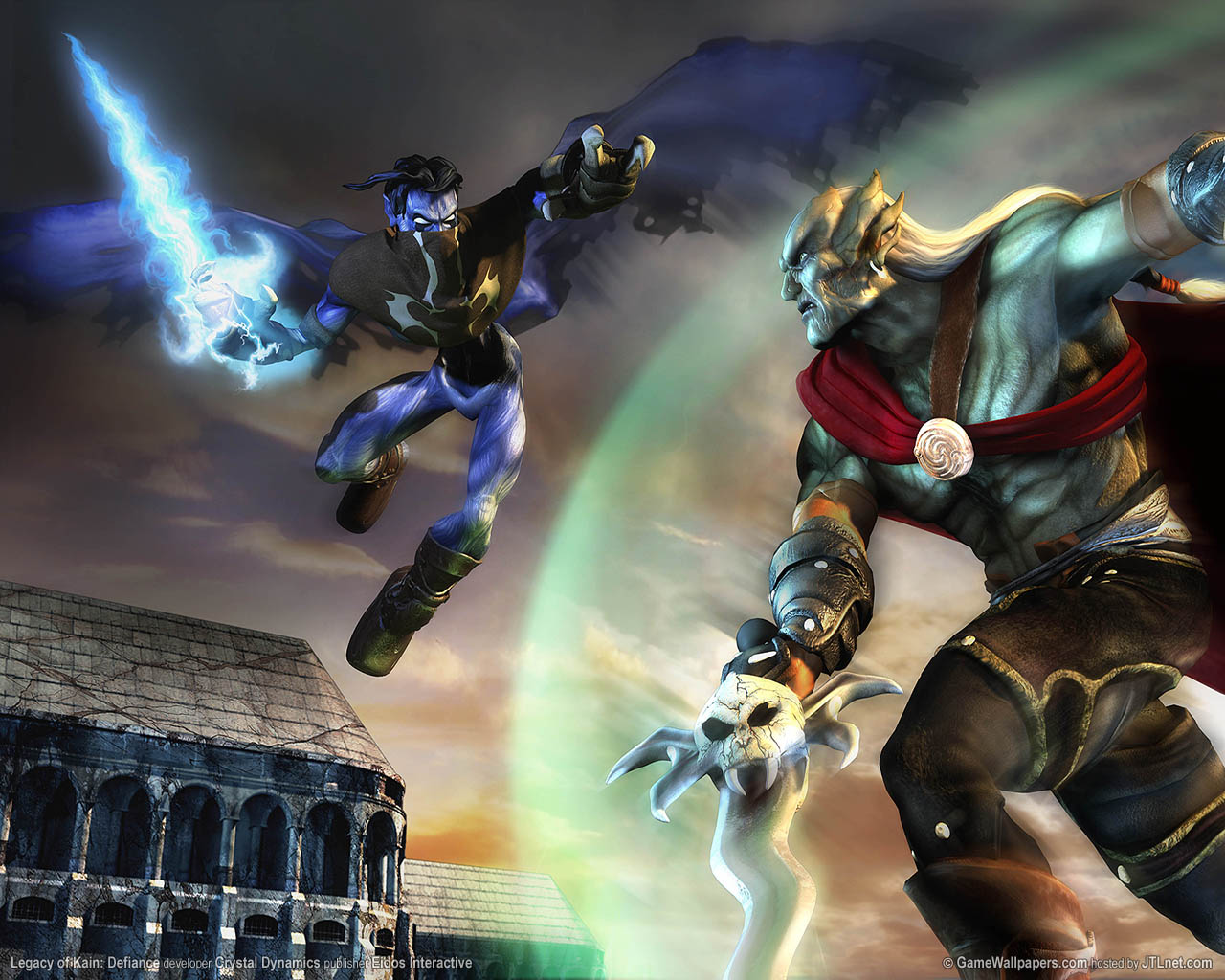
Tricked you - it's about Raziel AND Kain!
America's most popular 'tag's seem to fall into one of two groups: dialogue tree guys and Introspection d00ds. By dialogue tree guys, I mean characters that only say exactly what you tell them to say, but whose role in the story is otherwise fixed. A Commander Shepherd, if you will. The problem I have with these types is that they are very much a role, not a character. They are defined by their function, by the fact that they knock the story into place. They don't have flaws or personalities or arcs, they just chime in at mission-critical moments to keep things underway.

On the other end of the spectrum we have heartily defined protags like Max Payne and Ezio Auditore, whom I would call Introspection guys. They get enough exposition to drive me to suicide, but the actual action of the game is completely disconnected from their internal monologue. Max is totally fucked as a character because his search for purpose has nothing to do with cover-shooting in a graveyard, and his wanton murder streak goes a long way toward rendering the character a joke. Now we have a case where the protagonist has a persona, but is undercut by his status as an avatar. The player's love for killing things is making it impossible to connect with a character who shouldn't.

An alternative approach that pops up from time to time is Ishmael. You've read Moby Dick, right? You've got the famous first line tattooed across your shoulder-blades? "Call me Ishmael, but don't call me late for dinner!" Etc. To recap, Ishmael serves solely as a lens through which the audience views the drama. He himself is sidelined by the story arc. FFXII does this with ol' whatever-his-name is, Vahn, right? That's a weird name. Anyway, you play as Vahn, but he doesn't have anything to do with the story. It's about some losers named Bosch or Blathers or something. Don't think I liked the plot of that one. Too many evil bad-guy ghosts and secret twin brothers.

Anyway, it's silent protagonists that are the proper incarnation of Ishmael in gaming. Beyond all the mindless fan-adoration, Link has never been much of a hero at all. Sure, he usually brings together all the macguffins that draw the story towards its climax, but the true stories within each Zelda game are those of the non-player characters we meets along the way: Medli overcoming her timidity, Midna's exile, Makar doing whatever the fuck was the deal with him but god I loved that character, Groose accpting his own insignificance, etc. The greatest example, of course, is Majora's Mask, in which nearly every character has their own developing storyline encapsulated by the quest for the associated mask. Beyond Zelda, we could also have a look at Half-Life 2 and its narrative, viewed through Gordon Freeman but actually about Alyx and Eli Vance.
Remember the time in high school English when I filmed myself playing Wind Waker while one of my friends read from Moby Dick, and we called it a "re-enactment"?
I'm not saying "silent protagonists are the only good protagonists", even though it sounds like that's exactly what I said, because they were the only ones I discussed using a positive tone. There are plenty of good player characters that are correctly matched to the experience, like RE4's Leon Kennedy, quipmaster extraordinaire with just enough heart and charm to melt a young girl's icy heart. That said, young girls probably have the most meltable hearts out there. Legacy of Kain's Kain and Raziel are probably my all-time favorite leading men, thanks not only to stellar voice-acting, but in particular to their carefully drawn out and interweaving plot. Kain is developed through Raziel and vice versa. Jumping across chasms and solving switch-puzzles may not lend much to their characters, but their insatiable appetite and wanton destruction need to be witnessed to truly understand their roles as gods.

The end. Boy I'm tired of this post.

Tuesday, December 18, 2012

If you had all day to play video games....

at 2:27 PM
What would you play?  

This question isn't rhetorical.  I now have much more time on my hands than during the semester trudge.  Ezio and I are both graduating.  One of us has a job lined up.  One of us has enough money in the bank to support themselves for quite some time.  One of us isn't moving back home.  One of us is graduating with a double major.  One of us is more handsome.

Now while you sleuthers (?) are puzzling away at that little riddle-and-a-half, let's get back to the matter at hand.  What am I going to do with all this time?

Well I'm going to do a lot of hiking/camping.  But all that means is a lot of car trips with the ol' 3DS and a copy of Paper Mario Super Sticker Man, or whatever.  But my question is what other 3DS/DS games?  Because jesus I have not touched that system in months.  I ask this question knowing that no one play 3DS, so I do not have high hopes.  How about hidden DS gems though?  
Have I written a blog yet that didn't have some old dude's portrait in it?

And I'm going to try and put a dent in the reading list.  But, books?  Really?  What is this, 17th century Paris?  Who do I look like?  Jean Racine?  Moliere?  God I hope not.  My considerable (they can be considered) talents in the field of history have led some of my professors to encourage graduate school in the field (Ezio hasn't faced similar pressure for some reason), but I'm not going to sit around book-learnin'.  So there's Assassin's Creed games, to teach me everything there is to know about, like, all sorts of historical things, right?  Right!?  Honestly, I did spend way too much time in AC2 reading building histories.  Played that game the way it was meant to be played.

I am also going to watch a lot of Netflix.  Heck maybe I'll even peruse Yourself's MMM column for some tips!  Also I found this list which looks fairly solid.  But one can only stare at a TV screen for around 48 hours, tops, before one goes absolutely, incurably, utterly insane and starts gnawing at things in the living room.  And that's why we can't have nice things, Netflix!  So when the aching hunger sets in, the kind that leaves one feeling like nothing but fake leather upholstery will sate it, I will need to first take a deep breath, then a second, then plug in the PS3.  So what came out for that system again?

I need help here.  It's not like reviews are a good indication of quality.  Fellow bloggers, and *readers,* let me know if there is one must play game out there to fill my waking hours.

Thursday, November 1, 2012

Part 2 of Game Politics - Choosing sides

at 3:11 PM
I'm gonna take a little break from covering XCOM. It's getting monotonous for me, so I know it must be for everyone else. What better time to revisit my discussion of games focusing on political strife.

So last time we learned how dysfunctional the notion of Kingdom Versus Empire is. Beyond the void of historical basis; Kingdom Versus Kingdom, Nation Versus Nation, and Faction Versus Faction don't work either. Fictional political conflicts are very weak subject material - in my opinion, altogether, but for the sake of this post, specifically in games. Something games rely upon more than other media is making the player feel like they (through their in-game avatar) are acting for a purpose, that they're doing the right thing or at least know why they're doing what they're doing. That's the role-playing aspect of RPGs (contrary to popular belief, which holds that "role-playing" means score). Political motivation in real life is a plenty complex issue and difficult enough to inspire; doing it in a fictional realm is a near insurmountable challenge.
I'm going to pull a new example for this discussion: the Assassin's Creed series. Assassin's Creed III (about the sixth game in the series) debuted this week with its take on the Ammy Revolution, the birth of This World's First Free Nation (TM). I've yet to play, so let me tell you a little about Creed II. The game is set in Renaissance Italy, the 16th century or so, a time at which the region was dominated by independent city states. Readers of Machiavelli's science fiction diatribe, The Prince, will be familiar with this setting (Machia-V himself even makes an appearance in-game, as a time-traveler with lazer-hair). Ruling families and the church establishment duked it out for power on an almost continual basis. The ongoing Assassin's Creed epic, an eternal battle between two secretive societies known as the Assassins and the Knights Templar (think Freemasons), fits naturally onto this backdrop. The Assassins (that's the protagonists' side) run with certain historical families like the de Medicis, while the Templar are represented primarily by the Borgia (papacy).

A common means of making the player feel like he's joined the right side ("right" as in fitting - right for a hero would be good/just and right for a villain is something else) is to tie a personal goal of the character to a political faction - he needs to help X force in exchange for Y. Assassin's Creed II uses this approach; the protagonist's father is killed by the Templar, so he joins forces with the Asses to get revenge. He also learns his father and uncle are also secret Asses, and his teenage rival is the son of a Templar.

Well that's all real fucking convenient, huh?! This... is bad. Family ties and vengeance are emotionally oriented goals, no invigorating for the player than "go rescue a princess". There's no justice or heroism, no curiosity, nothing to make the player feel any shared stake in the conflict.

Worse yet, it trivializes your involvement in the overarching strife, dissociating the personal conflict from the political one to create an unfortunate dichotomy. I'm not saying two plot-lines is an unfeasible goal, I'm saying having one propped up entirely by the second makes it feel like fluff. Even if he does manage to empathize with the snobbish, prissy Ezio (no one should (oh I should note I mean Ezio the character, not the blogger here)), the player will be motivated by vengeance and familial dedication. A bunch of murders with political motives don't really fall within that justification.

Okay, so providing a personal attachment isn't good enough to make the player feel righteous in his shared struggle. You have to draw him in with the talking points as well. This is where Creed II falls so flat on its face that its brain explodes. From everything I can gather, the Asses' (remember, played by the Medicis) only goal is to kill Templars (Borgia), because the Templars killed some Asses, because the Asses killed some Templars before that, and so on. As X once said, "both sides are 'right', and both sides murder". There's also something about apples, like they both really like apples, but again it's the same on both sides. So really, the whole conflict feels fucked. Kind of pretty common for wars, oh well.

Then again, not all people think wars are bad. Some are Republicans or work for the military-industrial complex.
I most certainly did not make this image
HEY LOOK I JUST PISSED SOMEONE OFF A WHOLE BUNCH BY CHOOSING A SIDE! DID YOU SEE HOW THAT ILLUSTRATES MY POINT?! Next time I'm actually going to talk about some of the political subject matter used to get you fighting for a cause, in a feature I'm tentatively calling, "Part 3 of Game Politics".